When a designer receives a commission, thousands of ideas often immediately spring to mind. This feels good, and as a novice, one might be tempted to jump straight into designing. Experienced designers, however, know that if you do this, in many cases, the exact opposite of the desired effect occurs: The design usually looks quite good, and in your head, everything seemed so logical, but then you forget about usability and the client's wishes. Or even worse, it doesn't even aesthetically appeal – not to mention its technical feasibility. So, you've invested time and energy into work that needs to be completely redone. In the worst-case scenario, as a designer, you've already expended all your energy and no longer feel enthusiastic about the project you were so looking forward to. But it doesn't have to be this way.
Design consists partly of creativity and an instinct for beauty and appeal. But the second major part is functionality and logic. Even the most beautiful website loses all its charm if it's not logically structured and easy to use. I recently read a very good quote on this topic in an article by Ryan J. Morrison (see medium.com): "Every decision in your design needs to have purpose."
That sounds plausible. But how do I know what purpose my design decisions need to fulfil? For that, I need a lot of information about user needs, client requirements, and the details of technical implementation. Therefore, before I start designing and making corresponding decisions, I must thoroughly engage with these components.
1 Reference Material, Mood Boards & Sketches
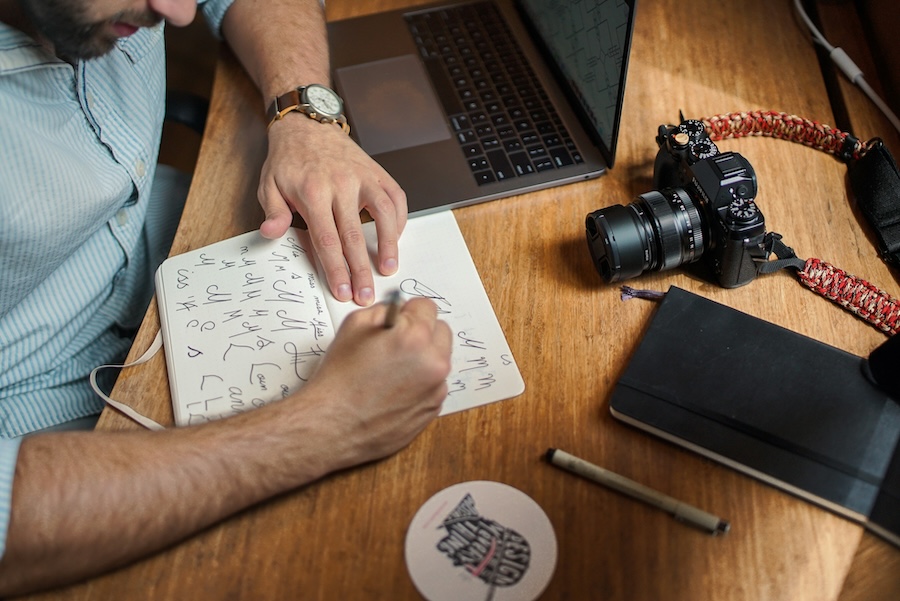
The ideas that come to mind at the very beginning of a project are extremely valuable and should never be discarded. Collections of reference material, mood boards, and sketches are the right methods to capture ideas during this conceptual phase. The best thing about these methods is that you can share them with the client and developers. For example, www.pinterest.com or gomoodboard.com are very well suited for this. First, a common denominator must be found with the client: the colour palette, typography, the style of images and illustrations, the icon style, the type of navigation, the amount and use of whitespace, and the general contrast need to be clarified here.
2 Long Live the Mockup
Once there is agreement on the visual concept, the next step follows, which is essential, especially for the usability of a website: creating mockups. Tools like Balsamiq make it easy for us to create a rough sketch of a website in a very short time, which can even be clicked through. The more content a website needs to accommodate and the more complex its interdependencies, the more important this step becomes. Usability tests can also be conducted beforehand with the mockups, showing whether users can find their way around the website and if the navigation design is immediately understood and correctly applied.
3 Get Together
Only when the website's structure has been clarified with the help of mockups does a renewed design step follow: bringing the elements from point 1 (reference material, mood boards, and sketches) into the form of point 2 (mockups). Some might say that these many planning steps inhibit creativity. But I disagree. It actually requires a high degree of creativity to not simply design new creative elements – whether borrowed or completely new – according to a rigid formula, but to shape them in a way that pleases the client, benefits users, and functions flawlessly technically.
This is also why a designer never gets bored. Every project is different because different users have different needs, and every client has a different taste. You just have to embrace it – and it always remains exciting!