
In my latest post, I delved into the two approaches – Content Marketing and Inbound Marketing – which are finally gaining traction in Austria. Judging by the comments and shares on the article, the topic is steadily increasing in relevance, albeit in small steps. All the more reason, then, to examine the issues raised in more detail. This time, the focus is specifically on Inbound Marketing. What exactly is it? What elements play a central role, and what does the Inbound Marketing cycle look like step by step?
What Exactly Does Inbound Marketing Mean?
As the opposite of ‘outbound’, ‘inbound’ essentially refers to all marketing measures that occur “below the line”. This includes all non-traditional analog and digital advertising measures. However, if we understand Inbound Marketing as a purely online approach, then Hubspot, as one of the strongest and most influential marketing automation software solutions, holds the interpretive authority.
According to the Hubspot website, this approach primarily involves creating relevant content to attract attention to the company and draw customers to the exact products they are genuinely interested in. The key subject areas in the Inbound Marketing understanding are:
- content creation,
- lifecycle marketing,
- personalisation of content and messages,
- the multi-channel approach, and
- the integration and automation of processes.
All these points and the resulting business goals are pursued through specific instruments, which are configured differently depending on the stage of the customer journey. These instruments include:
- Blogging (as a foundation)
- Creation of other relevant content formats, such as infographics, e-books, tables, videos, audios, images, etc.
- Online PR and Blogger Relations
- Social media and digital referral marketing
- Search Engine Optimisation (SEO) and Search Engine Advertising (SEA)
- Website optimisation, especially the use of landing pages
- Email marketing
- Customer Relationship Management (CRM)
- Analyses and statistical evaluations (mainly web analytics)
The field of Inbound Marketing is therefore very multifaceted and can hardly be explained in a single sentence. However, this is precisely one of its particular strengths: firstly, it is a new marketing philosophy, and secondly, it is a bundle of tools that must be adapted to the specific needs of the company, but also of the target group. I deliberately do not say “can” here, because only an individualisation of the approach will bring the desired success for the company.
How Does Inbound Marketing Work?
Now that we know the most important elements of the Inbound Marketing approach, we can put them into a logical and profitable sequence and thus answer the question of how Inbound Marketing actually works. The basic principle is very simple and can be clearly seen in this Hubspot graphic.
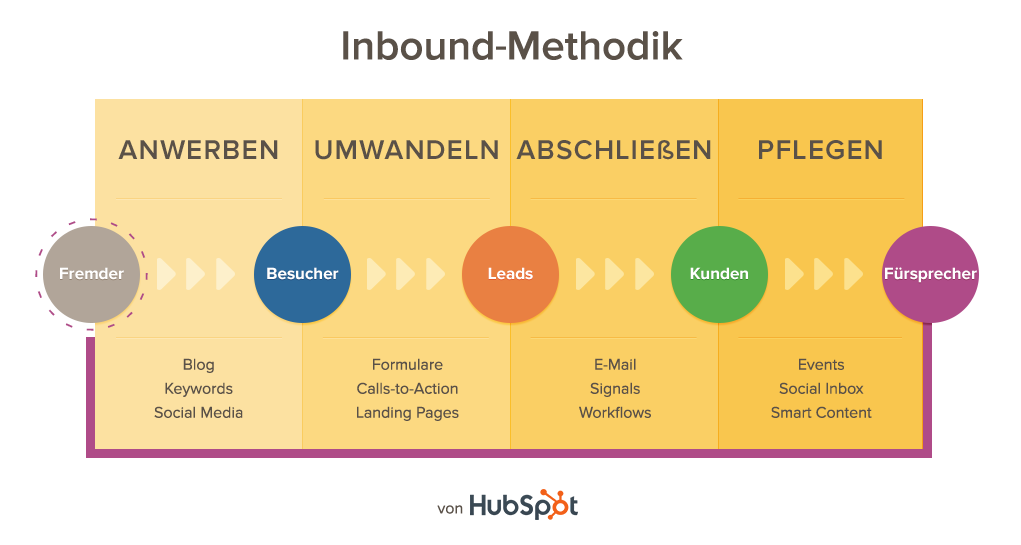
STEP 1: SEARCHERS BECOME VISITORS
In an age of content overload, one of the biggest challenges in online marketing is certainly attracting the attention of your target audience. It has long been known that classic advertising placements show rather limited success. However, this is not only due to the generally proclaimed “advertising blindness” or “advertising fatigue”, but also very much because people on the social web simply do not search for products or brands. They Google problems and want a tailored answer. They are looking for solutions.
So, to give an example, if I am again looking for a solution to my chronic back pain, I will type something like the following long-tail keyword (search phrase) into the search bar of my preferred search engine: “What helps with chronic back pain?”
A plethora of results will then be listed for me, not all of which are relevant. Painkillers, heat patches, gyms, fitness guides, ergonomic office equipment, physical medicine centres, and many others vie for my attention. If you do not appear on the first page here, you will probably never hear a single penny ring in your till from me. Not because you could not help me, but because I do not know that your solution even exists.
The first step is therefore to offer our target audience what they are actually looking for: answers! Our goal must be to turn searching users into our website visitors.
To achieve this, we have the following instruments available:
- Blogging: This is the beginning of all inbound activities, because only those who offer online content to their target audience can be found by users.
- SEO: To actually land on the first page of the search engine, online texts must also be optimised for it. The trend here is clearly away from keyword stuffing towards “user intent” – what is the user really looking for?
- Social Networks: To increase the likelihood of being found, we should also use social networks. This way, we spread our high-quality content and reach a larger dialogue group.
- Website Optimisation: Once the user has landed on the company’s website, a clear, structured, and intuitive website often makes all the difference. Does the user find what they were looking for? Is there further information? How high is the bounce rate, how long is the dwell time? All these and many other questions and points need to be clarified and optimised where necessary.
STEP 2: VISITORS BECOME PROSPECTS
Once on our company website, it is important to keep the visitor and engage with them. The actual goal is to establish contact with the potential customer, i.e., at least to obtain the website visitor’s email address.
Of course, users have become much more critical about their data since the NSA affair or the collapse of the Safe Harbour agreement, and do not disclose personal information “just like that”. In exchange for their data, Inbound Marketing offers various content formats, such as e-books, whitepapers, or checklists. It is important that the offered goodie matches the content that has just been consumed.
So, if I, to stick to my example above, click on a blog post from an office equipment supplier about ergonomic chairs and in that post receive tips for better posture when working at a desk, then, for example, a worksheet titled “Checklist for Healthy Computer Work” would be a relevant additional offer. If I liked the article I read and gained actual benefit from it, then the chances are good that I will indeed download this checklist in exchange for my email address.
At the end of the second step, we know about our potential customer that they trust us enough to be contacted regularly (e.g., in the form of a newsletter). We also know through which channel and on what topic this user came to our site. We can therefore identify a rough buyer persona silhouette.
What tools are available to us in this step?
- Call-to-Actions: These are calls to action, usually in the form of a button, that tell our visitor what to do next, e.g., “Download checklist”.
- Landing Pages: This is the page that the website visitor reaches after clicking the call-to-action. Here, the call to action is implemented. The user provides their data and thus officially becomes a “lead” or customer contact.
- CRM: From this point on, a detailed and categorised customer database should be used. Who is the potential customer? Where do they come from and what are they interested in? What have they downloaded? What is the quality of the interaction? How often have they been on which pages of the website and how long did they stay there? All this information can be recorded and provides important insights into user behaviour.
STEP 3: LEADS BECOME CUSTOMERS
The time it takes to turn a prospect into an actual customer can certainly be lengthy. Depending on the industry and product, we should approach this slowly so as not to alienate the generally positive lead with aggressive measures. There is indeed no standardised approach here. The only way is: try, measure, optimise.
This third step is the only one in the entire Inbound Marketing cycle that employs push measures for support. Advertising will now be actively perceived by the user again and, on the other hand, will no longer be considered intrusive. Retargeting is used here, as are personalised newsletter offers or calls from sales, but certainly not everything at once, but rather portioned and individualised.
It would therefore be quite conceivable for me to find an email in my inbox after a few days offering me a proprietary, ergonomic best-selling chair. Why not? I sit for many hours a day, have constant back problems, and by now I know that appropriate equipment and correct sitting can counteract postural damage and pain. I can, but do not have to, respond to the offer. It is now entirely up to the sales team's actions and the quality of the CRM tool whether and how our “relationship” continues.
To convert prospects into customers, we have the following instruments available in Inbound Marketing:
- CRM: Here, even more than in the previous step, a differentiated customer database is of great importance.
- Marketing Automation: To get the maximum out of our previous efforts, automating processes is extremely helpful. This couples email, customer database, offers, lead scoring (i.e., rating how “ready” a prospect is for company offers) and initiates the most sensible steps.
- Internal Analyses: Which content generates the most traffic, which the most leads? How long does it take on average from the first to the third step? Where do most visitors come from? Can existing buyer personas be refined through specific insights? How well do marketing and sales collaborate, and do the automation steps correspond to the actual CRM entries or customer needs?
STEP 4: CUSTOMERS BECOME FANS
After a completed purchase, we do not let our customers fall into oblivion in Inbound Marketing; quite the opposite. Inbound is a holistic and sustainable marketing approach that follows a cyclical movement. Website visitors, prospects, and existing customers remain in an active corporate dialogue driven by relevant content.
Specifically, this means we strengthen the bond with our existing customers through tailored content (thanks to our excellent CRM database) and provide further offers, if the customer is ready for them (see lead scoring above). We want to offer our customers a comprehensive and satisfying sales experience so that they become fans of our brand and convinced advocates for our company. If we succeed in generating authentic referral marketing from our customers, we can proudly say that we have achieved the goal of Inbound Marketing.
The sales team at the ergonomic office furniture supplier is successful, and the quality and benefits of the height-adjustable and individually adaptable chair convince me. The offer finally made to me is just the last “push” towards my purchasing decision. The personal conversation with the call centre staff, to whom I address my final detailed questions, is pleasant, non-promotional, and without pressure. I really do not feel like something is being frantically sold to me. Even after the purchase, I regularly receive tips on workplace health. All in all, a company I can unreservedly recommend to my best friend!
To win enthusiastic advocates, these tools are suitable:
- Social Media: Real-time customer service as well as tips and helpful micro-content on platforms where our target audience already spends time strengthens customer loyalty.
- Smart Offers: Personalised offers and calls-to-action are not only helpful but a must.
- Automated Marketing: Automated processes based on a solid customer database make our lives as marketers easier. However, this does not mean that this automation should be perceived negatively by the customer. Nobody wants to be a number!
Inbound Marketing Conclusion
Inbound Marketing is a multifaceted and sustainable pull marketing approach. Its strengths are its flexibility and adaptability, its long-term impact principle, and its personalised target group approach. Inbound Marketing is certainly a labour-intensive approach, but one that simultaneously conserves resources. Inbound Marketing is in any case an approach that turns previous methods on their head. Inbound is a mindset. The only question remains: Are you ready for it yet?