
Accessibility · News
Web Accessibility Certificate – Austria, here we go!
A high-calibre team from various companies and organisations, including Zensations, has come together and spent months developing a product that will now be realised with partners. What is regulated in Germany by the BITV-Test or offered in Switzerland by Access for All is now set to be introduced in Austria.
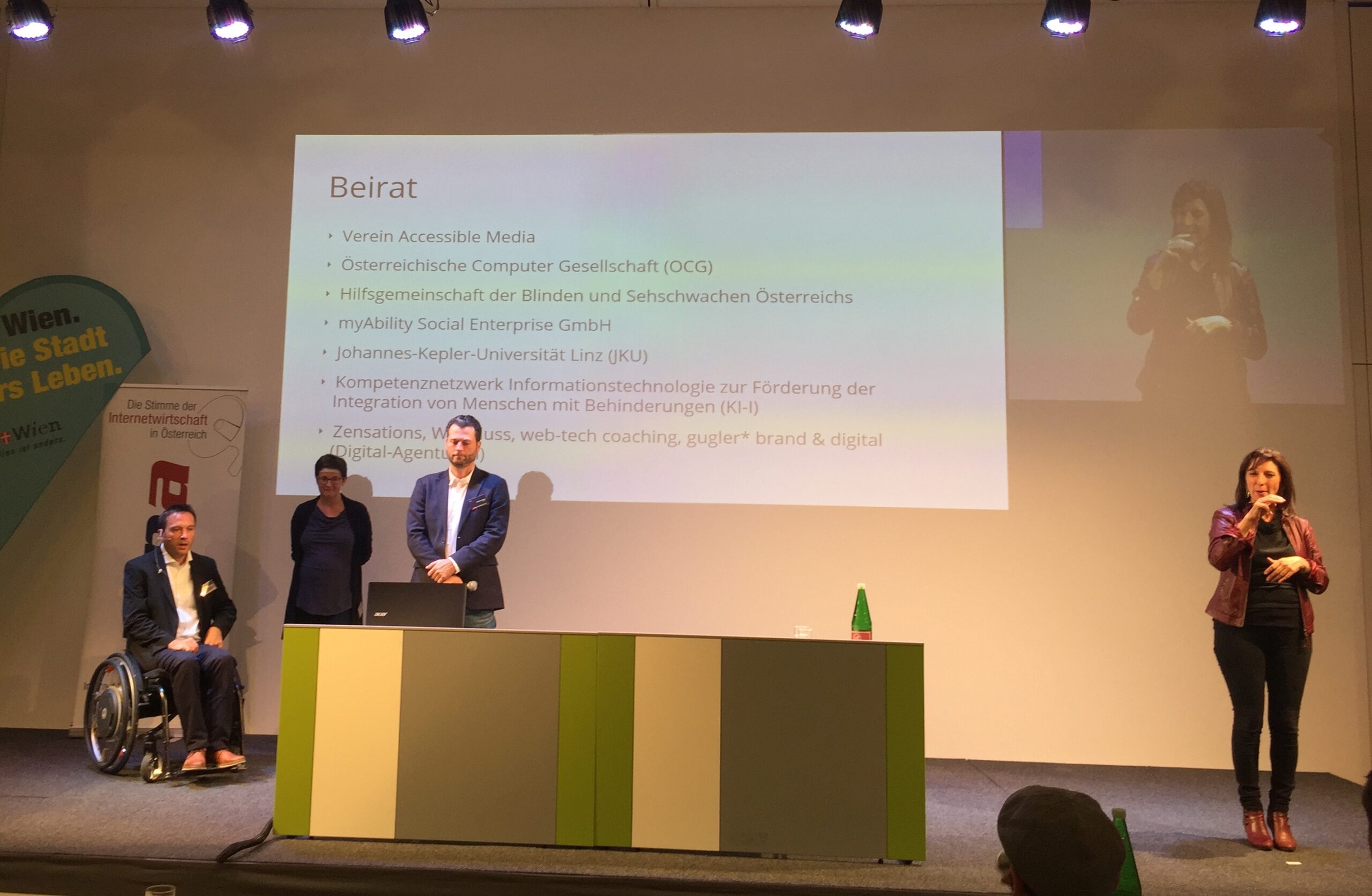
At this year's A-TAG, the moment finally arrived when a part of the ACERT project team stepped onto the stage and announced a project whose beginnings date back much further than its official launch in 2016. From that announcement, there was no turning back, and the final course was set to finally offer Austria a means of certifying accessible web applications. The presentation is available for download here!
How does a certification process work?
During discussions within the steering group, several options were considered, with agreement reached on an approach that supports existing company processes and is also cost-effective for applicants. There will be a central online hub where interested parties can obtain information on requirements and all relevant details.
As part of the certification process, applicants must submit an evaluation of their online presence / application in accordance with WCAG 2.0 AA, carried out by a qualified person or experienced agency. The sample forming the basis of the evaluation will be determined jointly with an OCG auditor. This step allows companies to conduct the process with agencies / partners already familiar with the site.
Three categories were envisioned based on size and complexity:
- Small and less complex websites (test sample up to 9 pages)
- Medium-sized and moderately complex websites (test sample up to 14 pages)
- Large and complex platforms (test sample up to 24 pages)
However, there are also tendencies towards a 4th category, aimed at very large and highly complex platforms (shops, e-banking, communities, etc.). In this category, a meaningful sample will be selected through a joint evaluation process, and an individual cost estimate will be made based on it. Demand will show the extent to which this is needed.
Once the evaluation reaches the certification body, the auditor will review it based on the sample or randomly select an additional number of pages (10-20%) to ensure that not only the sample has been optimised. If deficiencies are found, the company will be given an extension period to rectify them, otherwise, certification will be refused.
Can my website be certified?
The award for an accessible application is based on international standards to ensure recognised quality criteria underpin the auditing process, thereby enabling comparability beyond national borders. For this, WCAG 2.0 at conformance level AA was deliberately chosen, as it already serves as a criterion for accessible public sector websites and represents a balanced level of accessibility coupled with reasonable effort for content creation. For example, these are also referenced in EN 301549.
For the certificate to be awarded, these criteria must be fully met, with a grace period for applicants to rectify any shortcomings. To avoid pointless discussions: No, a single missing alt text or an incorrectly set heading hierarchy in an article are not deal-breakers.
If all criteria are met, the OCG will award the certificate in the form of a document, an entry in a database including an evaluation protocol, and a JS snippet. The snippet is a visually designed dynamic label that displays the current certification status, provides a link to the certification body's database entry, and offers a reporting service for barriers. This functionality offers many advantages to both website operators and the people who use the services. By certifying one's website, not only is social responsibility (CSR) communicated, but a quality assurance instrument is also utilised, as the results of optimisation are monitored by an independent institution. Any emerging problems can be reported directly by users to the operators. They have the opportunity to act quickly based on this free feedback and restore the website's functionality.
Due to the fast pace of current technologies and the fact that websites these days are almost exclusively constantly changing systems (new features, design relaunch, etc.), the certificate's validity has been limited to three years. After this period, and due to essential feature changes, a recertification of the respective areas or the entire site will take place to guarantee a consistently high level of accessibility.
An independent body decides
Objectivity is a crucial factor. Therefore, the renowned Austrian Computer Society (OCG) was chosen as the certificate issuer. Many will know this institution, led by Ronald Bieber, better from the ECDL (European Computer Driving Licence). Accessible Media, also an association, serves as the second instance and will be primarily responsible for auditors and the further development of the certificate under the OCG's umbrella. Through many years of experience and broad acceptance in politics, business, and among the public, a foundation has been created not only to establish a verified standard but also to enable long-term monitoring, which is also required by the European Commission. The database can provide a unique source for this.
Does Austria even need certification?
For many years, various organisations and think tanks have been striving to make the internet more accessible. A draft of WCAG 2.1 now exists from the W3C, although unfortunately the current version has not yet fully taken hold in everyone's minds. As an agency, we have experienced a shift in recent years and have noted a steadily growing interest and demand for services related to digital accessibility. But why do we now need a certificate for accessible websites, and why is it not enough to individually test based on WCAG?
The simple answer is: Yes! Because only through an independent body can a uniform standard and quality assurance be provided, leading to continuous improvement of systems. Companies can protect themselves in tenders with the help of this certificate, and consumers have the opportunity to report problems easily.
And finally, the team behind the project:
Edith Vosta (Federal Chancellery, Section VII/5) a.Univ.-Prof. Dr. Klaus Miesenberger (Johannes Kepler University Linz)
Mag. Klaus Höckner (Austrian Association for the Blind and Visually Impaired)
Pöll Daniel (Johannes Kepler University Linz)
Dr. Ronald Bieber (Austrian Computer Society)
Dipl.-Ing. Dr. Franz Pühretmair (Competence Network Information Technology for the Promotion of the Integration of People with Disabilities (KI-I)
Werner Rosenberger, MSc (Gugler)
Ing. Martin Weber (Gugler)
Mag. Michael Aumann (myAbility Social Enterprise)
Mag. Wolfram Huber (Web-Tech)
DI Michael Stenitzer (Wienfluss)
Mag. Maria Putzhuber (Wienfluss)
Jo Spelbrink (Zensations)
Wolfgang Leitner (Zensations)
Do you see the necessity for a certificate? We look forward to a lively discussion!